The story behind Amazing Grace begins with a remarkable contradiction: one of the world’s best-known hymns about forgiveness and redemption was written by a man who had participated in the transatlantic slave trade.
John Newton wrote the words in England during the 18th century, drawing on his religious experiences and reflections on his troubled past. Yet the song’s journey from a small English parish to international recognition would take generations.
Its familiar melody was added much later, and even some of the words commonly sung today did not belong to Newton’s original composition.
The history of Amazing Grace is therefore not simply the story of one man’s religious awakening. It is also a story of slavery, repentance, changing musical traditions and the remarkable ways a song can acquire new meanings over time.
Who Wrote Amazing Grace?
The words of Amazing Grace were written by John Newton (1725-1807), an English sailor who later became an Anglican clergyman and hymn writer.
Newton’s early life was turbulent. He spent years at sea, experienced severe hardship and eventually became involved in the trading and transportation of enslaved Africans.
In 1748, a violent storm nearly destroyed the ship on which he was travelling. Newton survived, and the experience became an important turning point in his religious life.
However, the transformation was neither immediate nor complete.
Newton continued participating in the slave trade for several years after the storm. He eventually left seafaring, entered the ministry and became associated with the campaign to abolish the trade.
His experiences helped shape the religious themes that would appear in Amazing Grace, although the hymn was written many years after the storm.
The Storm At Sea That Changed John Newton’s Life
In March 1748, Newton was travelling aboard the Greyhound, a ship returning towards Britain after a voyage connected with trade on the West African coast.
During the Atlantic crossing, a powerful storm battered the vessel. The crew struggled to keep it afloat, and Newton feared that he might die.
He later described how the experience caused him to reconsider his life and seek God’s mercy.
The ship survived and eventually reached safety in Ireland.
Newton came to regard this event as a significant moment in his spiritual awakening. However, his developing faith did not instantly transform his attitudes towards every aspect of his conduct.
This distinction is essential to understanding his story.
Did Newton Abandon The Slave Trade After The Storm?
No. Despite the popular version of events, Newton did not immediately abandon the slave trade following his experience in 1748.
He went on to serve as captain of ships transporting enslaved Africans across the Atlantic.
Newton left that career in 1754, following several voyages in which he had directly participated in the trade.
Years later, he publicly condemned the trade and acknowledged its cruelty.
In 1788, he published Thoughts upon the African Slave Trade, describing the suffering inflicted on enslaved Africans and lending his support to abolition.
He also provided evidence to parliamentary investigations and supported the wider abolitionist campaign.
Newton lived to see the British Parliament pass legislation abolishing British participation in the slave trade in 1807. He died in December of that year.
His involvement in slavery remains an essential part of his biography. His later opposition to the trade does not erase his earlier responsibility.
When And Why Was Amazing Grace Written?
Amazing Grace was most likely written in the final weeks of 1772, while Newton served as a minister in Olney, Buckinghamshire, England.
By this time, his religious life had taken a very different direction from his years at sea.
Newton regularly wrote hymns to accompany sermons and religious gatherings. These compositions helped his congregation reflect on biblical passages and their relevance to everyday life.
Amazing Grace was associated with his New Year’s Day service on 1 January 1773.
The sermon drew on 1 Chronicles 17:16-17, in which King David reflects on God’s generosity and expresses astonishment at the blessings he has received.
Newton connected this biblical theme with his understanding of divine mercy and his own experiences.
The resulting hymn explored spiritual transformation, forgiveness, guidance and hope.
The Original Title Was Not Amazing Grace
An easily overlooked detail is that Newton’s hymn originally appeared under the heading Faith’s Review and Expectation.
This title reflected the religious theme of looking back on divine guidance while anticipating what lay ahead.
Today, people almost universally identify the work by its opening words.
The original heading provides a useful clue to Newton’s intentions. Rather than concentrating solely on a dramatic moment of conversion, the hymn considers an ongoing spiritual journey.
The First Publication In Olney Hymns
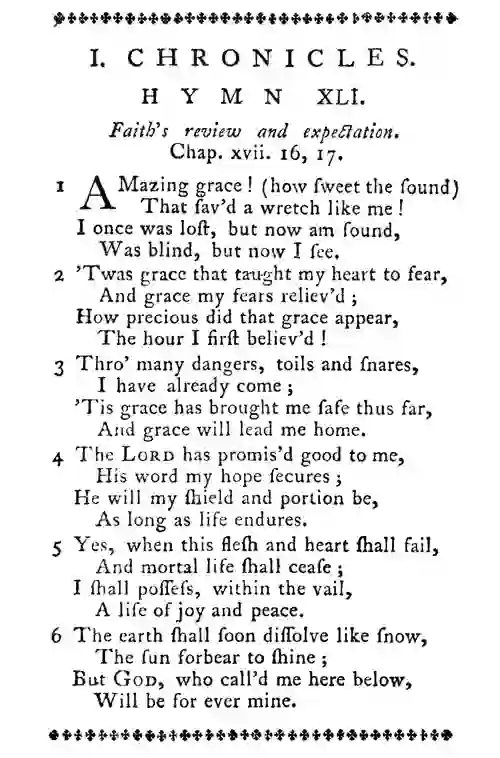
Amazing Grace first appeared in print in 1779, in a collection entitled Olney Hymns in Three Books.
The collection brought together religious verses by Newton and his friend, the poet William Cowper.
The two men had worked closely in Olney, sharing an interest in making religious ideas accessible through hymns and poetry.
The book contained 348 hymns, including 281 attributed to Newton and 67 to Cowper.
Amazing Grace appeared as Hymn XLI, the Roman numeral for 41, under the heading Faith’s Review and Expectation.
Crucially, the book printed the words without musical notation.
Readers could sing the verses to suitable familiar hymn tunes, rather than one fixed melody.
As a result, early performances may have used different melodies from the familiar tune heard today. The precise tune Newton’s congregation originally sang remains uncertain.
Where Did The Famous Amazing Grace Melody Come From?
The familiar melody of Amazing Grace was not composed by John Newton.
It emerged through American hymn-singing traditions during the 19th century, decades after Newton wrote the words.
The tune became known as New Britain. Its precise origins remain uncertain, although versions circulated in American tune collections before it became permanently associated with the hymn.
Versions of the melody appeared in American collections before 1835, including Columbian Harmony in 1829. These earlier publications paired related tunes with different hymn texts, rather than Newton’s Amazing Grace.
In 1835, American singing teacher William Walker published the pairing of Newton’s words and New Britain in The Southern Harmony, and Musical Companion.
This combination played a major role in establishing the version recognised today.
The melody has a simple, memorable character. Its earliest form uses five principal notes, creating a pentatonic structure found in many musical traditions.
That simplicity makes it particularly suitable for communal singing.
Why The Melody Was So Important
Newton’s original verses followed a regular poetic metre that allowed different musical settings.
When the words became closely associated with New Britain, the combination gained a distinctive identity.
The tune could support solemn reflection, but it could also carry powerful performances by large congregations, choirs and instrumental ensembles.
The melody’s flexibility helped the hymn travel beyond the religious gatherings for which Newton had originally written it.
What Do The Words Of Amazing Grace Mean?
At its heart, Amazing Grace is a Christian hymn about receiving mercy that a person believes they have not earned.
The word grace refers to God’s freely given favour and forgiveness.
Newton presents human weakness and spiritual transformation as central themes.
The song also looks beyond an individual’s past, expressing confidence in guidance through hardship and hope for what lies ahead.
Being Lost And Found
One of the hymn’s most recognisable ideas is the movement from being lost to being found.
Within the Christian context, this represents spiritual rescue and the discovery of faith.
The imagery also communicates something broader: the possibility of finding direction after confusion, despair or serious mistakes.
This helps explain why listeners who do not share Newton’s religious beliefs may still identify with the song.
Blindness And Understanding
The hymn also uses blindness and sight as metaphors for spiritual awareness.
Newton presents the experience of gaining understanding as a profound change in how a person sees themselves and the world.
The imagery has often been interpreted in connection with his personal transformation.
However, it would be misleading to assume that every part of the hymn refers specifically to his participation in slavery.
Its biblical context and broader religious themes are equally important.
Grace Through Difficult Times
Another central theme is the belief that divine grace provides guidance through danger, uncertainty and suffering.
For Newton, this would have carried particular significance because of his experiences at sea and his later religious life.
For other listeners, these themes may evoke personal hardship, recovery, bereavement or moments of change.
The distinction between Newton’s intended religious message and later personal interpretations is important. Both help explain the hymn’s enduring appeal, but they are not identical.
The Familiar Final Verse Was Added Later
Many modern performances of Amazing Grace include a closing verse referring to spending ten thousand years in heaven.
That verse was not part of Newton’s original six stanzas.
The additional verse has a history of its own. An earlier form appeared in a religious collection published in 1784, while a recognisable version appeared in A Collection of Sacred Ballads in 1790.
An important milestone came in 1852, when Harriet Beecher Stowe incorporated the verse alongside Newton’s words in her influential anti-slavery novel Uncle Tom’s Cabin.
In the novel, the character Uncle Tom sings words from Newton’s hymn together with the additional stanza.
Stowe did not originate the verse, but its appearance in her novel helped connect it with the familiar hymn.
Later hymn collections strengthened that association.
This is a revealing example of how songs can change through transmission, borrowing and performance.
The version people know best is not always identical to the work that its original author published.
Amazing Grace In American Musical History
Although Amazing Grace originated in England, much of its later development took place in the United States.
During the 19th century, it spread through religious revivals, camp meetings and hymn collections.
American shape-note singing traditions were particularly influential. These systems used specially shaped musical notes to help singers learn melodies and harmonies.
The practice encouraged participation by people who did not have extensive formal musical training.
Over time, Amazing Grace became part of numerous American religious traditions, including gospel music and African American church singing.
Its meanings also broadened as people used it to express faith, perseverance, liberation, mourning and collective hope.
The hymn’s history is especially complex because its author had participated in slavery, while the song later became associated with communities and movements confronting slavery’s legacy.
That contrast remains one of the most thought-provoking aspects of Amazing Grace.
Famous Recordings That Brought Amazing Grace To New Audiences
Amazing Grace has been interpreted by singers and musicians across gospel, folk, country, classical and popular music.
Several performances helped introduce the hymn to audiences beyond traditional church settings.
Mahalia Jackson
American gospel singer Mahalia Jackson helped bring spiritual and gospel music to wider audiences.
Her performances of Amazing Grace demonstrated the expressive power of the hymn within African American gospel traditions.
Jackson was also closely associated with the American civil rights movement, giving her musical legacy particular historical significance.
Judy Collins
In 1970, American folk singer Judy Collins recorded an a cappella arrangement of Amazing Grace for her album Whales & Nightingales. Although it featured no instruments, a small choir accompanied her singing.
The recording became an unexpected popular success.
Its restrained vocal arrangement drew attention to the melody and words without relying on elaborate instrumentation.
The Library of Congress selected Collins’ recording for the United States National Recording Registry in 2016, recognising its cultural and historical significance.
The Royal Scots Dragoon Guards
In 1972, the Pipes and Drums of the Royal Scots Dragoon Guards achieved major commercial success with an instrumental recording of Amazing Grace.
The performance brought the melody to another audience through the distinctive sound of Scottish military bagpipes.
Its success also demonstrated that the hymn’s emotional appeal did not depend entirely on its words.
Why Amazing Grace Still Matters
Amazing Grace has endured because it combines several powerful elements: an accessible melody, memorable imagery and themes that many listeners recognise in their own lives.
Its original meaning is unmistakably Christian, grounded in Newton’s understanding of divine grace.
Yet its wider appeal reaches beyond formal worship.
People encounter the hymn at funerals, commemorations, celebrations, public ceremonies and moments of personal reflection.
For some, it expresses religious faith. For others, it represents recovery, forgiveness, endurance or hope.
Its history also raises difficult questions about whether a person’s later repentance can change how their earlier actions are remembered.
Newton’s life offers no simple answer. His actions within the slave trade caused real harm, while his later writings contributed to the campaign against it.
Understanding both parts of that history provides a more complete picture of the man behind the hymn.
The Lasting Story Behind Amazing Grace
The story of Amazing Grace stretches from an 18th-century English parish to religious gatherings, social movements, recordings and performances across the world.
John Newton supplied the original words, but generations of singers, musicians and communities shaped the song that people recognise today.
Its journey shows how a work can develop far beyond its original setting, acquiring new associations without losing the ideas that first gave it meaning.
Perhaps the most remarkable aspect of Amazing Grace is that a hymn written to express one man’s understanding of mercy has become a way for countless other people to express experiences of their own.
Discuss Amazing Grace
What does Amazing Grace mean to you? Does knowing John Newton’s history change how you hear the hymn?
Join the conversation in the Songs And Poems Forum and share your thoughts about its origins, meaning and enduring appeal.
Sources And Further Reading
- Cowper & Newton Museum – Amazing Grace — The hymn’s origins, original title, Olney setting and first publication.
- Cowper & Newton Museum – Amazing Grace 250 Virtual Exhibition — Historical artefacts documenting Newton’s life, involvement in slavery and later abolitionist activities.
- Library of Congress – The Dissemination of Amazing Grace — The hymn’s development in America and the emergence of the familiar melody.
- Dictionary of Hymnology – Amazing Grace — Research into the original verses, later additions and the hymn’s publication history.
- Library of Congress – National Recording Registry: Judy Collins’ Amazing Grace — The history and recognition of Collins’ influential recording.
