How did nursery rhymes begin, and why have so many survived for centuries? The history of nursery rhymes stretches back through generations of singing, storytelling and children’s games, long before familiar verses appeared in illustrated books.
Some nursery rhymes developed from lullabies, songs, riddles and playful exchanges between adults and children. Others grew out of street songs, traditional games or verses passed directly from one generation of children to the next.
Their origins are often difficult to establish because much of this material circulated by word of mouth. By the time collectors wrote a rhyme down, its words, meaning and melody might already have changed considerably.
Familiar examples such as Humpty Dumpty, Jack and Jill, Hickory Dickory Dock and Ring a Ring o’ Roses have inspired countless stories about hidden historical meanings. Some interpretations are intriguing, but many are unsupported by reliable evidence.
The history is also much wider than English nursery rhymes. Children and families around the world have developed their own songs, counting verses, lullabies and singing games.
Understanding how these traditions began reveals something remarkable: a few memorable words can survive across centuries, changing as they pass between people, languages and cultures.
What Is A Nursery Rhyme?
A nursery rhyme is traditionally a short song or verse associated with young children.
Many use rhythm, repetition, memorable sounds and simple imagery.
Some tell stories, while others accompany games, help children remember information or provide amusement.
The term covers a wide variety of material rather than one strictly defined form of poetry.
A nursery rhyme might be sung as a lullaby, chanted during a playground game or recited without music.
Others began as poems written for children and became part of the traditional repertoire only after gaining popularity.
Do Nursery Rhymes Always Have To Rhyme?
No.
Although rhyme is a familiar feature, some traditional children’s verses depend more heavily on rhythm, repetition or patterns of sound.
A counting chant, for example, might use unusual or meaningless-sounding syllables.
A singing game may rely on a repeated refrain rather than matching line endings.
What connects these different forms is their association with children’s language, play and shared cultural traditions.
Are Nursery Rhymes The Same As Children’s Songs?
The terms overlap, but they are not identical.
Some nursery rhymes have well-known tunes, while others are normally spoken.
Children’s songs also include material that falls outside the traditional nursery-rhyme repertoire, such as school songs and more elaborate musical compositions.
A familiar verse may move between these categories over time.
Its words might originally have been spoken before a melody became widely associated with them.
When Did Nursery Rhymes First Appear?
There is no reliable date for the invention of nursery rhymes.
Songs and rhythmic verses have been shared with children for a very long time, but oral traditions rarely leave a complete historical record.
The earliest surviving written example of a particular rhyme does not necessarily reveal when people first began saying or singing it.
A verse recorded in the 18th century might already have circulated for several generations.
Conversely, a rhyme that sounds ancient may have been composed relatively recently.
Why The Earliest Nursery Rhymes Are Difficult To Date
Before sound recording, evidence depended largely on writing, printing and occasional references in other documents.
Much of what adults sang to babies or children exchanged during play was never written down.
Even when a rhyme appeared in a book, its author might remain unidentified.
Printers also adapted existing material, occasionally changing words or combining verses from different sources.
These practices make it difficult to establish one original version.
For many traditional rhymes, the most accurate historical answer is that their earliest known appearance can be identified, but their original composition cannot.
How Nursery Rhymes Developed Through Oral Tradition
Oral tradition was fundamental to the development of nursery rhymes.
Parents, grandparents, carers and older siblings passed familiar verses to younger children.
Other rhymes travelled directly between children through games, teasing, skipping and playground activities.
These two methods of transmission often overlapped.
A child might learn a song at home and introduce it to friends, who would then adapt it for their own games.
Why The Words Changed Over Time
When people pass on material from memory, variations can develop naturally.
Someone might forget a line, change an unfamiliar expression or introduce a new rhyme.
Children may deliberately alter words because they find the new version funnier.
Different pronunciations can also encourage changes.
A word that rhymes in one region may sound less suitable elsewhere, leading singers to choose a different expression.
Over generations, these small alterations can produce several recognisable versions of the same rhyme.
Children Helped Preserve Their Own Traditions
Nursery rhymes did not survive only because adults considered them worth teaching.
Children have long developed and maintained traditions of their own.
Clapping games, counting-out rhymes, skipping songs and playground chants can pass between children with little adult involvement.
Some continue for many generations while acquiring new words or movements.
This is an important reason why folklore researchers study children’s actual performances rather than relying exclusively on published collections.
A printed book may preserve one version, but a playground can preserve several others.
Were Nursery Rhymes Originally Written For Children?
Not all of them.
Some familiar verses were deliberately composed for young audiences.
Others developed from songs, jokes, riddles or traditional material that originally circulated more widely.
A verse might become associated with childhood because its rhythm was easy to remember or its imagery appealed to young listeners.
The distinction between adult and children’s entertainment was not always as clear as modern publishing categories suggest.
From Popular Songs To Children’s Verse
An existing song could gradually become shorter or simpler when passed to children.
A humorous refrain might survive after the rest of a longer composition was forgotten.
Adults might also adapt familiar words to entertain a child or accompany a household routine.
Over time, the shorter version could become more widely known than its earlier source.
However, such developments must be established individually.
It would be misleading to claim that every nursery rhyme began as a coded adult song or political satire.
Rhymes Created Specifically For Young Readers
As books for children became more common, writers increasingly produced original verse designed for young audiences.
These poems could be educational, humorous, moral or simply entertaining.
Some became popular enough to be remembered and repeated outside their original books.
Eventually, the distinction between anonymous traditional rhymes and works by identifiable authors became blurred.
This helps explain why a poem written by a named author can later be regarded as a traditional nursery rhyme.
The First Printed Nursery Rhyme Collections
One of the most important developments in nursery-rhyme history occurred in London in 1744.
That year, bookseller Mary Cooper published a small collection called Tommy Thumb’s Song Book.
The surviving historical evidence indicates that a related volume, Tommy Thumb’s Pretty Song Book, followed during the same year.
Together, these publications represent a landmark in the printing of English nursery rhymes for children.
Tommy Thumb’s Pretty Song Book
Only two original copies of the 1744 second volume are known to survive, held by the British Library in London and Princeton University’s Cotsen Children’s Library in the United States. The first volume has not survived.
It was extraordinarily small, measuring approximately 7.6 by 4.4 centimetres.
The pages combined short verses with illustrations.
Some printed lines appeared in red ink and others in black.
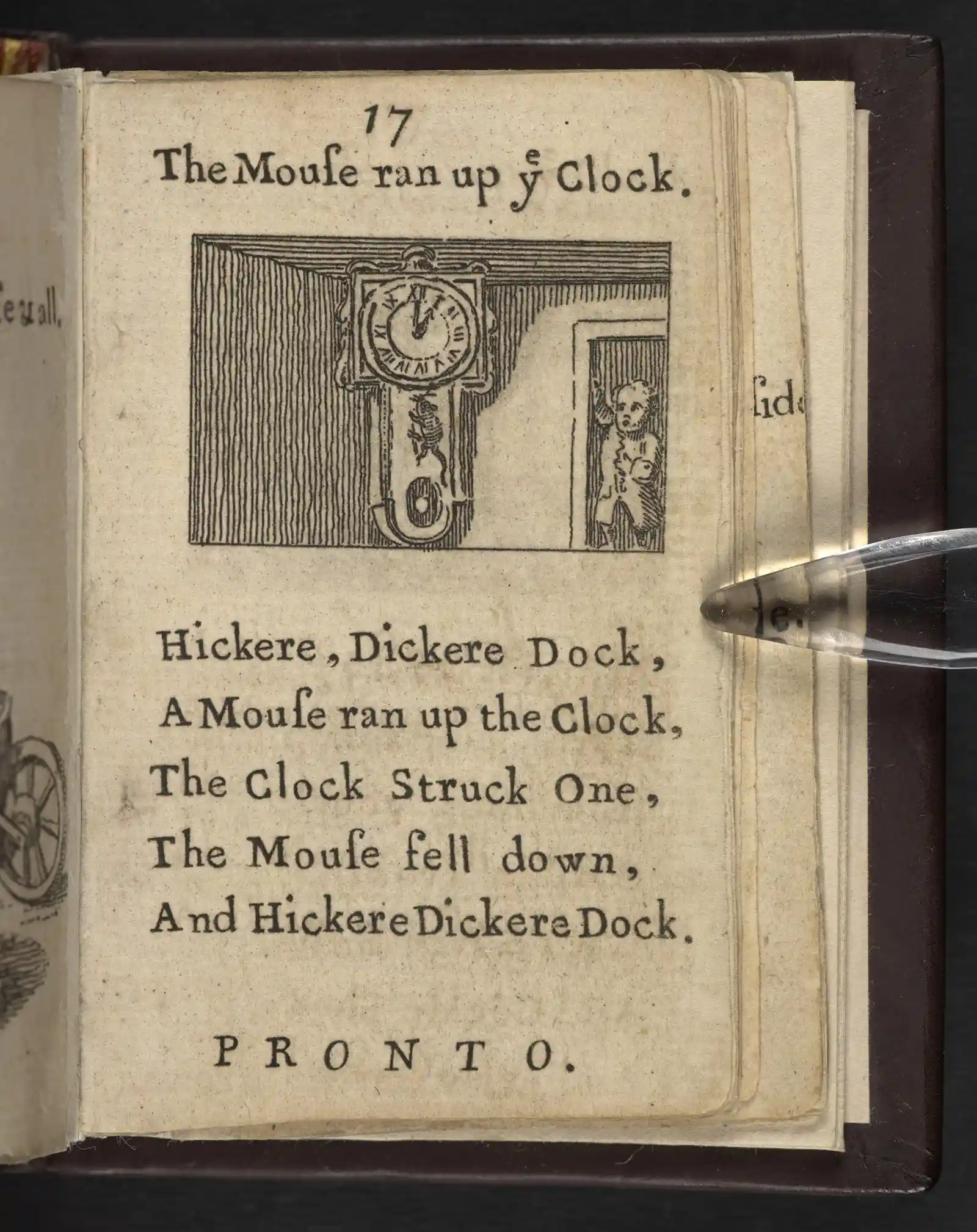
One surviving page contains an early version of Hickory Dickory Dock, featuring a mouse and a clock.
The book shows that children were already being offered familiar oral material in a compact, illustrated format.
Why The Missing First Volume Matters
The publication history is more complicated than a simple claim that one surviving book was the first nursery-rhyme collection.
An earlier volume was advertised and published in 1744, but no copy is known to survive.
The surviving Pretty Song Book belongs to that early publishing series.
Consequently, historians distinguish between the earliest documented publications and the earliest surviving physical examples.
That is an important difference.
A lost book can sometimes be established through advertisements and later evidence, even when its pages can no longer be examined directly.
What Early Nursery Books Tell Us
These tiny books demonstrate that printers had recognised a market for material designed to entertain young children.
They also reveal how printed collections began preserving rhymes that might otherwise have survived only through performance.
However, publication did not freeze the tradition.
People continued singing and adapting the verses outside books.
Printed and oral versions could develop alongside one another.
Who Was Mother Goose?
Mother Goose is one of the most familiar names associated with nursery rhymes, particularly in Britain and North America.
Yet there is no reliable evidence that all the traditional rhymes were written by one historical woman known as Mother Goose.
The name developed through storytelling, book publishing and the gradual association of a fictional figure with traditional children’s literature.
Mother Goose And French Fairy Tales
An important early connection appeared in France during the late 17th century.
Charles Perrault published a collection of fairy tales in 1697 that became closely associated with the expression Mother Goose.
Its stories included material that later became famous internationally through translations and retellings.
However, fairy tales and nursery rhymes are not identical literary forms.
Perrault’s connection with Mother Goose helps explain the name’s popularity, not the invention of every rhyme later published under it.
Mother Goose In English Children’s Books
During the 18th century, British publishers increasingly used the Mother Goose name when presenting songs and verses for children.
A collection titled Mother Goose’s Melody became particularly influential.
Its publication history involves editions associated with John Newbery and his publishing successors.
The name eventually became a convenient label for familiar rhymes, whether their original authors were known or not.
In the United States, “Mother Goose rhymes” became an especially common expression.
Was Mother Goose A Real Person?
Several historical figures have been proposed as the inspiration for Mother Goose.
However, such identifications are speculative and do not establish one author behind the tradition.
The figure is best understood as a literary and cultural symbol rather than a verified creator of the nursery-rhyme repertoire.
The surviving books offer stronger evidence for the history of the name than stories attempting to identify a particular grandmother.
Why Are So Many Nursery Rhymes Strange Or Dark?
Nursery rhymes frequently contain surprising events.
Animals speak, characters suffer improbable accidents, and familiar scenes suddenly become absurd.
Some verses include falling, injury, danger or death.
These details can seem unexpected in material associated with very young children.
However, strange imagery does not automatically indicate a concealed historical tragedy.
Humour, Surprise And Nonsense
Children often enjoy exaggeration, impossible situations and unexpected endings.
A rhyme can be funny precisely because its events are unlikely.
Unusual words may also survive because they produce a satisfying rhythm.
Some nursery-rhyme imagery makes more sense as playful nonsense than as an elaborate symbolic message.
That does not prevent individual verses from having historical associations, but such connections require evidence.
Why Modern Readers Search For Hidden Meanings
A familiar verse may contain words or events that no longer fit everyday experience.
Readers naturally wonder whether its meaning has been forgotten.
This curiosity has encouraged interpretations involving monarchs, revolutions, executions, epidemics and political conflict.
Some explanations are plausible possibilities.
Others depend on coincidences or stories recorded centuries after the alleged events.
The difference between an appealing interpretation and a documented origin is essential.
Was Ring A Ring O’ Roses About The Plague?
One of the most persistent nursery-rhyme origin stories claims that Ring a Ring o’ Roses, also known in North America as Ring Around the Rosie, describes the Black Death or the Great Plague of London.
The theory interprets flowers, sneezing and falling down as references to plague symptoms, attempted protection from disease and death.
It is memorable, but historical evidence does not support it.
What Does The Historical Evidence Show?
The rhyme’s well-documented English-language appearances date from the 19th century, long after the plague outbreaks with which it is commonly associated.
Its wording also varies considerably.
Some versions contain sneezing sounds, while others do not.
Different versions describe participants falling down, curtseying, squatting or performing other movements.
These variations are more consistent with a children’s singing game than with one fixed description of a historical disaster.
When Did The Plague Explanation Become Popular?
The Library of Congress has examined the development of this interpretation.
Its research traces the familiar plague explanation to the 20th century rather than to accounts written during the plague itself.
There is no known contemporary evidence establishing that children sang the rhyme about the Great Plague of London in 1665.
Folklorists therefore regard the plague story as an unsupported explanation.
The belief itself has become a kind of folklore: a traditional story about the supposed meaning of another traditional story.
What Was The Rhyme Used For?
Historical examples identify it as a singing game involving children moving together in a circle.
The words could accompany actions such as bending, sitting or dropping to the ground.
Some versions also contain elements associated with courtship games.
Its precise earliest origin remains uncertain, but its documented use as a children’s game provides a firmer explanation than the unsupported plague theory.
What Is The Real Meaning Of Humpty Dumpty?
Humpty Dumpty is another rhyme surrounded by popular historical claims.
Stories have associated the character with monarchs, military equipment and events during the English Civil War.
One familiar explanation describes Humpty Dumpty as a cannon that fell from a wall during the siege of Colchester.
However, the existence of such a story does not establish that the rhyme originally referred to the event.
Humpty Dumpty As A Riddle
An important part of the rhyme’s history is its association with riddles.
The familiar answer is an egg, although the verse itself does not necessarily identify the character as one.
A riddle can describe something ordinary in an unexpected way.
Once the answer becomes widely known, later illustrations may make the interpretation appear obvious.
The character’s visual identity also developed through literary representations, including appearances in later children’s books.
Why The Cannon Story Is Uncertain
A convincing historical explanation would need evidence connecting the words to the alleged incident.
Similarities between a falling object and a military event are not enough.
The cannon interpretation remains an unproven theory rather than an established origin.
The most responsible approach is to explain the rhyme’s riddle tradition and acknowledge that its earliest history is uncertain.
Did Jack And Jill Refer To Real Historical People?
Jack and Jill has also attracted stories connecting its characters to particular historical figures.
Various explanations involve kings, financial measures or political events.
However, these claims often depend on associations made long after the alleged circumstances.
The rhyme’s familiar narrative concerns two characters going uphill to fetch water and suffering an accident.
Its simplicity, rhythm and memorable sequence make it suitable for recitation.
The Problem With Political Interpretations
The names Jack and Jill have been used for ordinary or representative figures in English-language tradition.
Their appearance does not automatically identify particular real people.
To establish a political interpretation, historians would need stronger evidence than a resemblance between the rhyme’s characters and historical names.
Several competing explanations cannot all be treated as established facts.
The original meaning remains uncertain.
How Did Hickory Dickory Dock Begin?
Hickory Dickory Dock provides a particularly interesting connection between oral tradition and early printed children’s books.
An early version appeared in Tommy Thumb’s Pretty Song Book in 1744.
Its wording was not identical to every version familiar today.
The example demonstrates that traditional rhymes can change over time while retaining a recognisable rhythm and central image.
Why The Opening Words Are Memorable
The phrase “Hickory Dickory Dock” contains a strongly rhythmic sequence.
Its sound is more important to the rhyme than any straightforward dictionary meaning.
The repeated syllables create momentum before the brief story begins.
The mouse, clock and striking hour then introduce a simple narrative that is easy to remember.
Was It Invented To Teach Children The Time?
The presence of a clock has encouraged educational interpretations.
The rhyme can certainly be used when introducing clocks or numbers to young children.
However, a modern educational use does not establish its original purpose.
There is insufficient evidence to identify one definite inventor or prove that time-telling instruction was the reason for its composition.
Rock-A-Bye Baby: A Rhyme Older Than Its Famous Tune
Rock-a-bye Baby demonstrates that the history of a nursery rhyme’s words can differ substantially from that of its music.
The words appeared in the 18th-century collection Mother Goose’s Melody, associated with John Newbery’s publishing business.
However, the melody now widely recognised developed much later.
Who Wrote The Familiar Melody?
The familiar musical setting is credited to Effie I. Canning, also known by the names Effie Crockett and Effie Carlton.
Her song was published in 1886.
The melody helped establish the lullaby in a form that later singers and performers continued to recognise.
Canning’s contribution is often overlooked because the rhyme itself is treated as anonymous traditional material.
Yet it shows how a recognisable song can combine words from an earlier tradition with music created by a named composer.
Does The Falling Cradle Have A Hidden Meaning?
Several explanations have connected the rhyme to particular historical events or childcare practices.
However, the evidence does not establish one definitive hidden meaning.
Lullabies do not always describe peaceful or comforting events.
They can contain warnings, strange imagery and unsettling situations even when sung in a soothing manner.
The calming effect often comes from the melody, voice and rhythm rather than from a literal interpretation of every word.
Who Wrote Twinkle, Twinkle, Little Star?
Unlike many anonymous traditional rhymes, the words of Twinkle, Twinkle, Little Star have a known author.
They were written by Jane Taylor, an English poet born in 1783.
Her poem was originally titled The Star.
It appeared in Rhymes for the Nursery, published in 1806.
Jane and her sister Ann Taylor produced influential collections of poetry for children.
How A Written Poem Became A Nursery Rhyme
The Star was originally a literary work by an identifiable writer.
Over time, its opening lines became familiar through singing, recitation and children’s education.
Its later musical association helped the poem circulate far beyond its original printed setting.
Many people recognise the verse without knowing Jane Taylor’s name.
The example demonstrates that nursery rhymes do not all originate in anonymous folk tradition.
Some were deliberately written for children before becoming so familiar that their authorship was largely forgotten.
Did Mozart Compose Twinkle, Twinkle, Little Star?
The familiar melody is based on a French tune commonly known as Ah! vous dirai-je, maman.
Wolfgang Amadeus Mozart composed a set of piano variations on that melody.
He did not invent the underlying tune or write Jane Taylor’s poem.
The distinction matters because the history of a nursery rhyme can involve separate contributions from a poet, a traditional melody and later composers or arrangers.
How Nursery Rhymes Became Popular Through Books
Printed collections helped preserve nursery rhymes and introduce them to larger audiences.
The growth of children’s publishing during the 18th and 19th centuries encouraged more specialised books for young readers.
Illustrations became an important part of their appeal.
A familiar verse could be accompanied by pictures that made its characters easier to imagine.
The Influence Of Victorian Children’s Books
During the Victorian period, publishers produced a wide range of illustrated collections.
Some gathered traditional material, while others included newly written poems.
Artists contributed images that helped establish familiar visual versions of characters and stories.
The growth of affordable printing also made it easier for rhymes to reach homes and schools.
However, collecting a rhyme in a book could influence which version became most familiar.
Printed editors sometimes selected, rearranged or altered material from oral tradition.
Did Books Preserve Or Change Nursery Rhymes?
They did both.
Books provided a record that later readers could consult.
At the same time, a printed edition might establish one wording while other versions continued circulating orally.
Illustrations could also influence interpretation.
A character who began as an ambiguous figure might gradually acquire a familiar appearance through repeated publication.
The history of nursery rhymes is therefore partly the history of the relationship between changing oral traditions and more permanent printed texts.
How Nursery Rhymes Spread Around The World
Short children’s verses and songs are found in many different cultures.
They may accompany sleep, play, counting, storytelling, movement or learning.
However, it would be misleading to treat every international children’s tradition as a direct descendant of English nursery rhymes.
Some developed independently within their own languages and cultural settings.
Others travelled through migration, translation, education and commercial publishing.
Children’s Songs In Different Languages
A song written for children in one language may rely on sound patterns that cannot be reproduced exactly in another.
Translation can change rhyme, rhythm and even the structure of a game.
Some communities adapt foreign songs to familiar melodies or local experiences.
Others retain material that has been passed down through their own oral traditions.
The result is a rich range of children’s verse with both shared functions and distinctive cultural features.
Why Migration Changes Nursery Rhymes
Families moving between countries often carry familiar songs with them.
Children may learn traditional verses at home while encountering different material at school or among friends.
Words can change to reflect local expressions and pronunciations.
A rhyme may acquire a new melody or become associated with a different game.
The Library of Congress has documented how children’s songs and games circulate through migration and contact between communities.
This helps explain why familiar rhymes can exist in several countries without having exactly the same words or performance traditions.
The Importance Of Local Variations
A version remembered in one region should not automatically be treated as the only correct form.
Traditional material changes through use.
A rhyme may survive in multiple legitimate versions, each reflecting a particular community.
Preserving these differences is valuable because they reveal how folklore develops.
It also helps avoid the mistaken assumption that every nursery rhyme must have one original, unchanging text.
Why Do Children Remember Nursery Rhymes So Easily?
Nursery rhymes often combine several features that support memory.
Rhythm creates predictable patterns.
Repeated words reinforce familiar sounds.
Rhyme encourages listeners to anticipate what comes next.
Short narratives provide memorable sequences of events.
Actions and gestures can strengthen the association between words and movement.
Rhythm, Repetition And Sound
A memorable rhythm gives a verse a recognisable shape.
Children can join in with a repeated phrase even before remembering every word.
Rhyming endings also connect parts of the verse.
Unusual sounds and playful expressions may make it enjoyable to repeat.
These features help explain why a short rhyme can become familiar after repeated listening.
Nursery Rhymes And Language Development
Singing and reciting rhymes can provide opportunities for children to notice sounds, practise words and participate in shared language activities.
Rhyming games may help develop awareness that spoken words contain smaller sound units.
However, nursery rhymes should not be presented as a guaranteed method of improving every child’s language or reading ability.
Their effects depend on age, language experience, individual needs and the wider learning environment.
Their value also extends beyond formal education.
They can provide enjoyment, interaction and a sense of connection between people.
Why Are Nursery Rhymes Used In Children’s Games?
Many nursery rhymes are connected with movement and social activity.
Children may sing while moving in circles, clapping hands, skipping ropes or choosing participants for a game.
The words help organise the activity.
A repeated rhythm can coordinate movement, while a final phrase signals that something should happen.
Counting-Out Rhymes
Counting-out rhymes are used to select someone for a particular role in a game.
They may contain numbers, invented syllables or apparently meaningless expressions.
Their purpose often matters more than their literal meaning.
Different communities can develop their own versions.
Some older forms also contain language that later generations have replaced because it became offensive or unsuitable.
These changes form part of the tradition’s continuing development.
Clapping And Skipping Rhymes
Clapping and skipping games combine words with repeated movements.
Their patterns may become increasingly complicated as children learn them.
A rhyme can travel through playgrounds without appearing in a book or recording.
Children also invent variations and introduce new references from their own experiences.
This demonstrates that nursery-rhyme traditions are not merely historical survivals.
They can continue changing through children’s creativity.
Did Nursery Rhymes Originally Have Educational Purposes?
Some did, but education was not the sole reason they developed.
Counting rhymes could help children practise number sequences.
Other verses might introduce animals, familiar objects or everyday activities.
Some were used to communicate moral lessons or encourage particular behaviour.
However, many existed primarily for entertainment, comfort or participation in games.
Learning Through Play
Short verses can provide opportunities to practise sound patterns and remember simple sequences.
When accompanied by movement, they also encourage coordination and group participation.
Yet the existence of a useful educational application does not prove that a traditional rhyme was invented for that purpose.
For example, a modern teacher may use Hickory Dickory Dock when discussing clocks.
That does not establish that teaching time was the rhyme’s original intention.
Moral Lessons And Children’s Literature
Some authors deliberately wrote poems for children with a clear moral message.
These became particularly prominent in certain periods of children’s publishing.
Traditional nonsense rhymes, by contrast, might offer little obvious moral instruction.
The coexistence of serious lessons and absurd entertainment is an important feature of children’s literary history.
Nursery rhymes have never served only one purpose.
Can The Original Meaning Of A Nursery Rhyme Be Discovered?
Sometimes.
A dated publication, identifiable author or contemporary reference can provide reliable historical evidence.
Other rhymes remain difficult to explain because the earliest surviving records are incomplete.
The problem is especially significant when a modern interpretation relies on an event centuries before the first documented appearance of a verse.
What Counts As Good Historical Evidence?
Researchers look for early printed texts, manuscripts, reliable eyewitness accounts and references in contemporary writing.
They compare different versions and consider how the words changed over time.
A connection with a historical event becomes more convincing when evidence from the relevant period supports it.
A resemblance between a rhyme and a famous story is not enough on its own.
Why Some Origin Stories Are Misleading
Popular explanations can sound convincing because they assign familiar characters or strange events to recognisable moments in history.
However, a theory may begin as speculation and later be repeated without its uncertainty.
Eventually, websites and books may present it as established fact.
This is particularly common with claims that nursery rhymes conceal references to royal scandals, executions or epidemics.
A responsible account should distinguish documented origins, plausible interpretations and unsupported legends.
Common Misconceptions About Nursery Rhymes
Several widespread assumptions deserve correction.
All Nursery Rhymes Were Written By Mother Goose
Mother Goose is a literary figure associated with collections of children’s stories and rhymes, not the verified author of the entire tradition.
Every Nursery Rhyme Has A Dark Hidden Meaning
Some contain unsettling events or reflect historical circumstances, but many are playful, nonsensical or connected with children’s games.
Ring A Ring O’ Roses Definitely Describes The Plague
The popular plague interpretation lacks historical evidence and is not accepted as an established origin by folklorists.
Humpty Dumpty Was Certainly A Cannon
The cannon explanation is one of several later interpretations. A direct historical connection has not been demonstrated.
Nursery Rhymes Were Invented In The Victorian Period
Many existed before the Victorian era. English printed collections date from the 18th century, and oral traditions are older.
Every Nursery Rhyme Has One Original Version
Traditional rhymes often exist in several forms that developed through oral transmission.
All Nursery Rhymes Have Anonymous Authors
Some, including Twinkle, Twinkle, Little Star, developed from poems written by identifiable authors.
Children’s Rhymes Are The Same Everywhere
Children’s verse is found internationally, but individual cultures and languages have distinct traditions, forms and histories.
Why Nursery Rhymes Still Matter
Nursery rhymes preserve much more than familiar childhood entertainment.
They reveal how words and melodies travel between generations.
Their changing versions provide evidence of regional language, social customs and children’s creative participation in folklore.
Early printed collections show how publishers began recognising children’s entertainment as a distinct part of literary culture.
Later books, songs and recordings helped familiar material reach wider audiences.
Yet oral tradition remained important.
Families and children continued to alter, preserve and reinvent verses independently of publishers.
Nursery rhymes also demonstrate how easily historical speculation can become accepted as fact.
The distinction between documented history and attractive legends is therefore central to understanding them.
The Lasting History Of Nursery Rhymes
The history of nursery rhymes is not the story of one inventor, one country or one collection of poems.
It is a history of lullabies, singing games, riddles, playful language and verses passed between generations.
Some familiar English rhymes were circulating before their first recorded publications, while others were deliberately written for children and later became part of traditional culture.
Books such as Tommy Thumb’s Pretty Song Book helped preserve this material during the 18th century.
The Mother Goose publishing tradition introduced it to further audiences, while later writers and illustrators transformed its appearance.
Across the world, children continued developing their own songs and rhymes through play, family life and cultural exchange.
Their lasting appeal lies in a combination of memorable sound, simple language and the pleasure of sharing something familiar.
Although the original meanings of many individual rhymes remain uncertain, their continued transmission shows how a few short lines can become part of a community’s cultural memory.
Discuss The History Of Nursery Rhymes
Which nursery rhymes do you remember from childhood? Did your family sing different words from those commonly printed in books? Have you encountered unusual versions in another country or language?
Share your memories and opinions in the Songs And Poems Forum, including local variations, favourite verses and stories about how you learned them.
Sources And Further Reading
- Discovering Children’s Books – Poetry and Rhymes (MyLearning and the British Library) – Historical examples of early children’s verse, including the miniature Tommy Thumb’s Pretty Song Book of 1744.
- Library of Congress – Finding Mother Goose – A research guide tracing the Mother Goose tradition from French fairy tales to English-language children’s publishing.
- Library of Congress – Ring Around the Rosie: Metafolklore, Rhyme and Reason – Folklore research explaining why the popular plague interpretation is unsupported.
- Library of Congress – Rock-a-Bye Baby: Down Will Come Baby, Cradle and All – The publishing history of the words and the later composition of the familiar melody by Effie I. Canning.
- Poetry Foundation – Jane Taylor – Biography of the author of The Star, later known as Twinkle, Twinkle, Little Star.
- Library of Congress – Children’s Songs – Research and historic recordings demonstrating how children and adults share songs across different communities and traditions.
